
One Day Professional Development BOOT CAMP
A one-day, 4.0 PDH professional development experience built for engineers, architects, and contractors responsible for the design, detailing, protection, and repair of concrete structures. If you’re responsible for designing, detailing, protecting or protecting concrete structures, you cannot afford to miss this day!
March 3 @ 8:30 am - 4:30 pm
- This event has passed.
Event Details
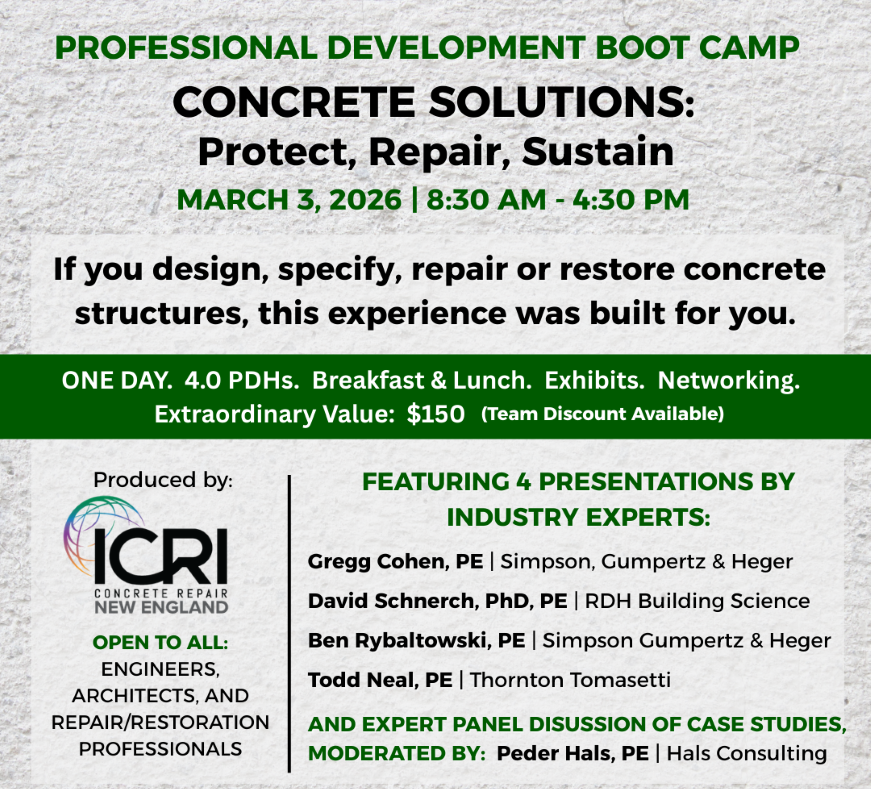
PROFESSIONAL BOOT CAMP THEME: CONCRETE SOLUTIONS: PROTECT, REPAIR, SUSTAIN
FEATURING: 5 Presentations, 4.0 PDH Certificate, Vendor Exhibits, Breakfast & Lunch, Raffle & Networking Opportunities
LOCATION: Granite Links, 100 Quary Hills Drive, Quincy MA
A one-day professional development experience built for engineers, architects, and contractors responsible for the design, detailing, protection, and repair of concrete structures.
This isn’t theory. It’s practical, actionable strategy for designing durable concrete structures, diagnosing deterioration accurately, specifying smarter repairs, and navigating industry changes that directly impact project outcomes and client budgets.
Whether you are designing new structures, detailing complex rehabilitations, or managing long-term performance of structures, this Boot Camp equips you with the insight to make better decisions.
IN ONE POWERFUL DAY, YOU WILL:
> Earn 4.0 Professional Development Hours (PDHs) from four 1-hour presentations
> Learn how initial design and detailing decisions influence long-term durability
> Discover a systematic framework for evaluating multi-factor deterioration
> Explore detailing strategies for aggressive and cold-climate environments
> Understand when to specify alternative reinforcement and corrosion mitigation systems
> Gain insight from 20+ years of MGH garage maintenance
> Review industry trends shaping repair scope, cost, and performance expectations
> Participate in live panel discussion of real-world challenges and solutions with industry leaders
> Connect with engineers, consultants, contracting professionals and suppliers
> Visit tabletop exhibits featuring innovative repair products & services
> Enjoy breakfast, lunch, and networking
You’ll leave with sharper diagnostic insight, stronger detailing strategy, and a clearer understanding of how today’s decisions affect tomorrow’s performance.
Register today and strengthen your approach to durable concrete design and repair!
11 QUESTIONS THIS BOOT CAMP WILL ANSWER
For Structural Engineers, Architects, and Concrete Repair/Restoration Professionals:
[1] Why do similar concrete structures perform dramatically differently over time?
[2] Why do some concrete repairs fail prematurely — even when the design seems sound?
[3] How do multiple small specification and construction deficiencies align to trigger premature deterioration?
[4] What is the most effective framework for diagnosing multi-factor concrete distress?
[5] Which detailing strategies extend service life in chloride-laden and freeze-thaw environments?
[6] When should stainless reinforcement, FRP systems, or cathodic protection be incorporated into repair design?
[7] How do you balance initial repair cost with long-term life-cycle performance?
[8] What does a successful 20-year concrete maintenance strategy look like in practice?
[9] How do contractor execution, owner expectations, and engineering decisions intersect over decades of maintenance?
[10] How are evolving building codes and industry standards influencing concrete repair scope and liability?
[11] How are building codes, material trends, and economic shifts reshaping concrete repair design decisions?
SCHEDULE:
8:00 – 8:30 Setup for table top exhibitors
8:30 – 9:30 Registration / Coffee & Light Breakfast / Welcome by Chapter President
9:30 – 10:30 Presentation 1 – “The Swiss-Cheese Model of Concrete Deterioration: When Multiple Deficiencies Align” by David Schnerch, Ph.D, PE of RDH Building Science
10:30 – 10:45 Break / Time to visit table top exhibits
10:45 – 11:45 Presentation 2- “Detailing of Concrete Repairs: Designing for Durable Repairs in Aggressive Environments – by Ben Rybaltowski, PE of SGH
11:45 – 12:00 Break / Time to visit table top exhibits
12:00 – 1:00 Lunch break & 30 min Keynote Address (Starting at 12:15) Keynote Presentation – Concrete Repair Industry Trends by Gregg Cohen, PE of SGH
1:00 – 2:00 Presentation 3 – Innovation, Relationships and Concrete Repair: 20 Years of Garage Maintenance at MGH- By Todd Neal of Thornton Tomasetti
2:00 – 2:15 Break / Time to visit table top exhibits
2:15 – 3:15 Presentation 4 – Case Studies and Panel Discussion Moderated by Peder Hals, PE of Hals Consulting
3:15 – 4:30 Closing by Chapter President / Drawing for Raffle Prizes / PDH certificate pickup / cocktails
INVESTMENT:
ATTENDEES: $150 each (Member + Non-members) DEADLINE TO REGISTER: MARCH 2
(Includes: 5 Presentations, 4.0 PDH Certificate, Vendor Exhibits, Breakfast, Lunch, Raffle, Networking Opportunities)
SPECIAL 5-FOR-4 OFFER: 5 Tickets for the price of 4 (20% off per person = $600 total for 5 tickets in one order)
SPONSOR OPPORTUNITIES: DEADLINE TO REGISTER: FEB 25
TABLE TOP EXHIBITOR: $300 ea. + REQUIRED Raffle Prize ($100.00+ value)
Includes: One attendee ticket plus table top display space.
Boot Camp attendees will receive raffle tickets by visiting all table tops and obtaining a signature from each exhibitor.
LUNCH SPONSOR OPPORTUNITY: $1,500 (One available)
Includes: One attendee ticket, one table top exhibit, recognition as Event Sponsor during opening introduction and closing, and dedicated banner at the registration booth.
PRESENTATION HIGHLIGHTS:
VIEW FULL PRESENTATION ABSTRACTS HERE
The Swiss-Cheese Model of Concrete Deterioration
by David Schnerch – RDH Building Science
Why do similar structures perform so differently? Why do many repairs fail prematurely?
Dr. Schnerch introduces a powerful diagnostic framework based on the Swiss-cheese model, to help practitioners understand how multiple vulnerabilities align to create failure pathways. This session will transform how you evaluate deterioration, and design repairs that address root causes, not just symptoms.
Designing for Durable Repairs in Aggressive Environments
by Ben Rybaltowski – Simpson Gumpertz & Heger
Learn best practices in detailing, material specification, alternative reinforcement systems, and cathodic protection strategies that extend service life and reduce life-cycle costs.
Includes applicable ACI & ICRI guidance and case studies.
20 Years of Garage Maintenance at MGH
by Todd Neal – Thornton Tomasetti
What does long-term concrete maintenance really look like?
A 20-year case study from Massachusetts General Hospital reveals lessons in client collaboration, contractor coordination, and phased repair strategy.
Industry Trends Keynote
by Gregg Cohen – Simpson Gumpertz & Heger
How are building codes, materials, and economic conditions reshaping concrete repair?
This keynote will explore regulatory changes, demolition planning, material selection, and how market shifts may impact repair strategies and project costs.